Precision prototyping at Tonsley is expanding South Australia’s capabilities across defence, aerospace and MedTech
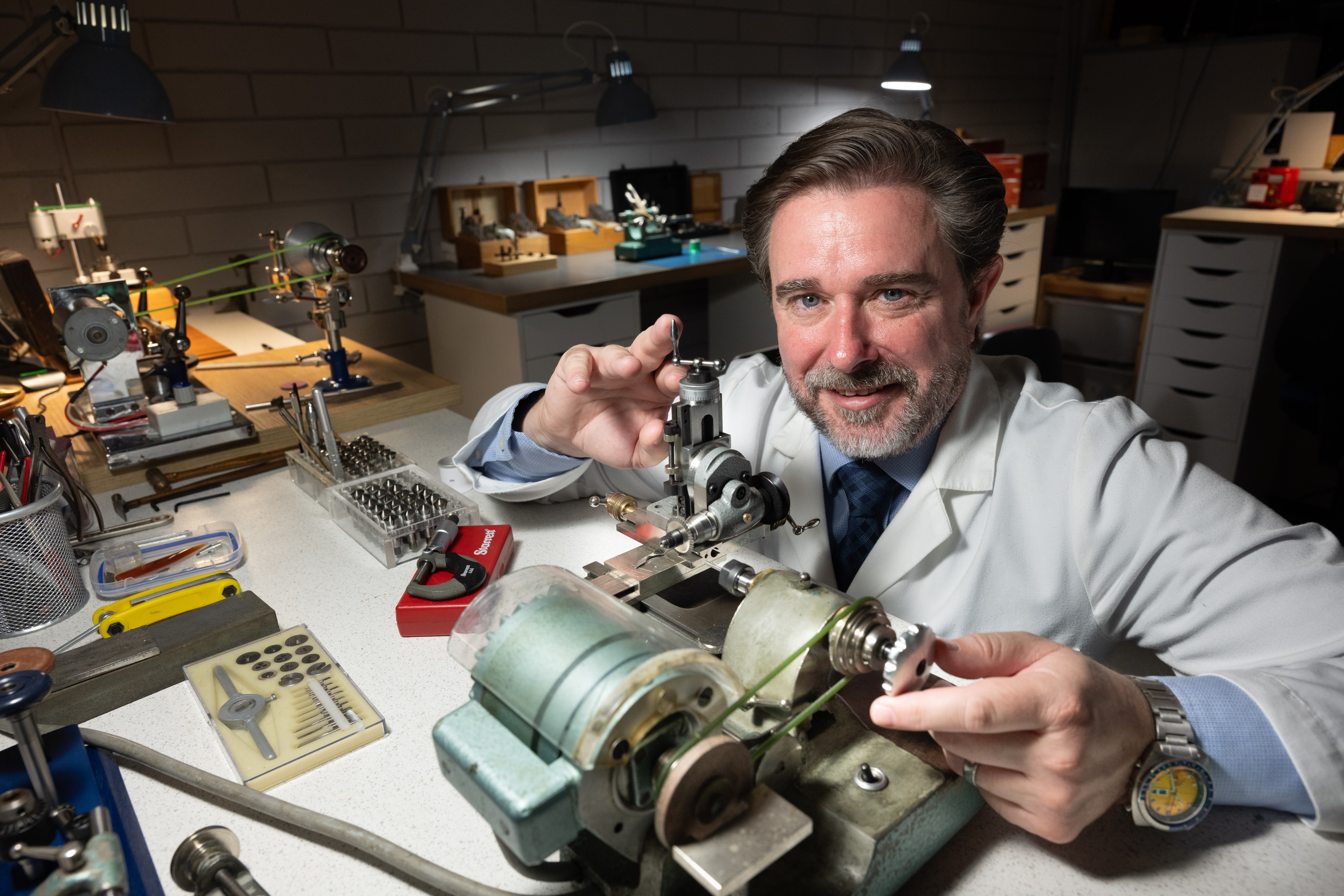
Precision mechanical and electro-device prototyping company McMahon Micro is repurposing its traditional watchmaking skills and machinery to support South Australia’s defence, aerospace and MedTech industries.
Led by Director and Founder Richard McMahon, McMahon Micro combines horology expertise – the science, art and study of watchmaking – with advanced precision engineering capability to deliver bespoke prototypes, proof-of-concept development and fault-finding services. Based at the Tonsley
Innovation District, the company specialises in rapid prototyping, assembly, testing and the manufacture of precision mechanical and micro-mechanical devices for aerospace, defence and medical technology applications.
As an official supplier to Defence SA and the South Australian Space Industry Centre (SASIC), the company partners with organisations to solve complex engineering challenges and strengthen domestic supply chains.
Also operating his watchmaking business, R. McMahon Watchmakers, Mr McMahon – a trained micro electronics and micro machining prototype engineer specialist with over 30 years’ experience – has pivoted his focus towards growing McMahon Micro, particularly with the acceleration of defence projects in South Australia and the state’s increased focus on expanding its space industry.
“There’s a strong push from both the state and federal governments to get working on increasing our industries capabilities, so South Australia can build full manufacturing capability,” he said.
“At the moment government are assessing what other organisations and McMahon Micro can contribute, so we can work together to build capability that supports both defence and importantly the space sector.
“Space is becoming a very big deal in Australia, especially Adelaide, and there is a narrow window to get this right. If we don’t step in and build the capability now, in five years it’ll be too late.
“We’ve missed opportunities before, so as a state we need to push forward and commit to growing the industry because if we act decisively now, we won’t look back.”
This forecasted growth in work for the space industry has prompted Mr McMahon to explore establishing an office at Lot Fourteen to align more closely with SASIC, creating a hub for meetings, CAD design, surface scanning and certification.
Further expansion at Tonsley would follow if additional manufacturing work is secured within the space industry, with the plan to expand McMahon Micro’s operations to be a precision manufacturing business along with continuing its prototype development.
“If we were to secure more work from the space industry, we would look at expanding our in-house manufacturing capabilities at Tonsley by having a dedicated precision manufacturing facility,” Mr McMahon said.
“With the new Technical College and Factory of the Future next door, it would be a great pipeline to recruit graduates with the potential manufacturing expansion hopefully being a large employment opportunity.
“If production increases such as making more brackets, components or sensors for satellites or other space applications we would train technicians locally at Tonsley and ensure everything is manufactured, certified and verified on site.”
McMahon Micro carries out its work in-house at its Tonsley Innovation District workshop, where it develops proof of concept prototypes and troubleshoots technical challenges. It also collaborates with the
Australian National Fabrication Facility, using equipment at both Flinders University’s New Ventures Institute and the University of Adelaide’s Mawson Lakes campus, where prototyping, atomic processes and tolerance testing are done.
The advantage of the combined Tonsley and Mawson Lakes workshops gives McMahon Micro a range of capabilities from rapid prototyping on manual machines to precision repeatable parts manufacturing on modern high-precision mill machines that can cut to micron levels.
“I use machines built in the 1960s and 70s that are still the best on the market. Some were used by the Department of Defence to produce precision instrumentation during World War Two, and today they are once again supporting the defence and aerospace industries,” Mr McMahon said.
“I have the highest-precision manual milling machine in the country, which allows me to manufacture parts to micron-level tolerances. Some of the machinery I use can cut to tolerances down to the scale of a hydrogen atom with each pass.”
As a certified master watchmaker Mr McMahon designs, machines and assembles micro machinery himself, identify issues, quickly adapt design and manufacture changes.
The watch industry has long been a powerful driver of technological innovation, with many of the technologies we now consider critical, first beta-tested in cheap LCD watches.
“The same advancements developed for watchmaking helped pave the way for breakthroughs in medical science and even space technologies,” Mr McMahon said.
“Once it proved reliable, it moved beyond the wrist and into the medical world finding its way into products including pacemakers, implants and other essential technologies such as satellites.
“Now days traditional product development requires every small change to be sent back through the certification process, creating endless loops that add thousands of hours and drive-up costs.
“My approach is to rapidly build a device that functions properly, then hand it back for the organisation to pull apart and go through certification once its right, cutting months or even years from the timeline.”
Since moving to Tonsley in 2022 Mr McMahon has benefited from the collaborative environment and shared expertise on site.
“Being here at Tonsley I’m part of the hub where I get on well with organisations including SAGE and Micro-X, and we can talk about projects and give each other advice,” Mr McMahon said.
“I’ve assisted a few companies here at Tonsley with developing individual components for devices they were building when they may have got stuck on something.
“I also provide informal advice and guidance to people at Flinders University when they need assistance with troubleshooting, if they have questions about what materials to use or how to simplify a mechanical device.”
Stay up to date with the latest news, developments events and activities at Tonsley Innovation District